
Employee Resourcing & Costing Optimization: A CFO's Strategic Guide
Transform workforce planning from a cost center to a strategic advantage. Learn how CFOs can optimize employee resourcing across multiple geographies while ensuring tax efficiency, compliance, and measurable business outcomes.
Employee Resourcing & Costing Optimization

Introduction: The Hidden Costs of Poor Workforce Planning
For most of the organizations, workforce spending is no longer a fixed cost-it's a strategic variable that shapes profitability, compliance posture, and investor confidence. Yet, many organizations continue to overlook the hidden costs of poor workforce planning. In the rush to scale operations, expand across borders, or integrate acquisitions, workforce decisions are often made in silos-optimized for headcount numbers rather than total cost, tax efficiency, and compliance impact.
This narrow focus can quietly drain margins. What appears as a cost-efficient hire in one jurisdiction may later translate into excessive tax exposure, double social contributions, or penalties under FEMA (Foreign Exchange Management Act), transfer pricing, or PE (Permanent Establishment) rules. Studies indicate that misaligned global hiring structures and non-compliant cost allocations can inflate employment-related expenses by up to 20-30%, eroding EBITDA (Earnings Before Interest, Taxes, Depreciation, and Amortisation) and cash flow predictability.
The reality is clear: modern workforce planning requires CFOs to integrate finance, HR, and compliance data into one strategic model. True optimization means understanding not just how many people a company employs, but where, under what structure, and at what post-tax cost. By embedding tax intelligence, regulatory guardrails, and inter-company cost logic into workforce design, CFOs can turn employee resourcing into a lever for capital efficiency—not a liability.
In an era of distributed work and global growth, workforce architecture is a financial strategy. The CFO who treats it as such gains a decisive edge in cost control, compliance resilience, and shareholder value creation.
Section 1: The Multi-Geography Challenge - Why Location Matters for Employee Costs
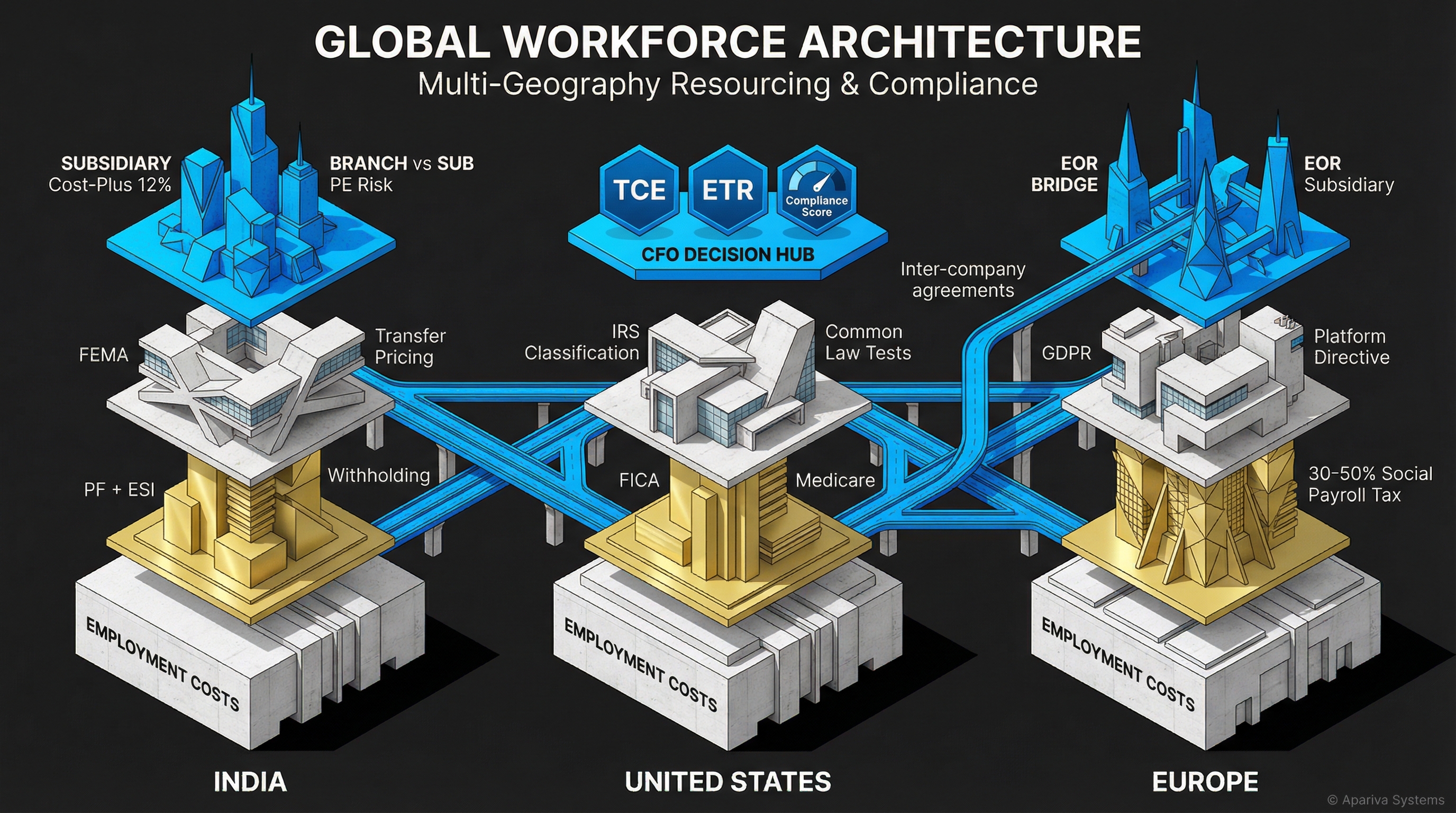
For today's CFOs, the question isn't just how many employees the business can afford-it's where those employees sit. In a globalized workforce model, location is now a strategic financial variable, shaping total employment cost, tax exposure, and compliance obligations. Each jurisdiction—India, the U.S., Europe, or APAC—adds its own complexity to payroll, benefits, and regulatory reporting. Missteps in modeling these nuances can directly erode EBITDA and invite costly tax scrutiny.
Why Location Matters for Employee Costs
An employee's country of work determines not only salary levels but also mandatory social contributions, employer taxes, and cost recovery rules.
For instance, hiring in India involves statutory obligations under the PF (Provident Fund) and ESI (Employee State Insurance), whereas in the U.S., employers bear FICA (Federal Insurance Contributions Act) and Medicare burdens. In the EU, payroll taxes and social benefits can account for 30-50% of gross salary, impacting overall labor cost competitiveness.
For CFOs, this means the same dollar of compensation can have drastically different after-tax and compliance-adjusted costs depending on geography. Strategic workforce modeling must therefore include net-to-gross analyses, factoring in exchange rates, benefit mandates, and local employment norms to reveal the true 'cost of seat.'
Tax Jurisdictions and Their Implications
Cross-border resourcing introduces another layer of complexity—jurisdictional tax exposure. Transfer pricing, double taxation treaties, and PE (Permanent Establishment) risks can alter profit attribution and tax obligations. For example:
- A U.S. entity paying Indian engineers directly may create an unintended PE in India, triggering local corporate tax liabilities.
- Shared service centers performing group functions must comply with arm's-length pricing under OECD (Organisation for Economic Co-operation and Development) and local transfer pricing rules.
- Payments to foreign employees or contractors fall under FEMA and withholding tax regimes, demanding careful routing and documentation.
CFOs must therefore orchestrate tax, finance, and HR functions to ensure every employee's cost aligns with the correct entity, country, and function, maintaining both compliance and tax efficiency.
Common Pitfalls Companies Make
Many CFOs underestimate the hidden costs of non-alignment. Common missteps include:
- Paying overseas staff without considering withholding or equalization requirements
- Treating long-term contractors as vendors, risking misclassification penalties
- Ignoring inter-company chargebacks or failing to maintain transfer pricing documentation
- Overlooking currency fluctuations and foreign exchange compliance under FEMA
Such gaps can result in tax adjustments, reputational damage, and operational disruptions during audits or due diligence. In essence, global workforce strategy is not just about scaling talent—it's about owning the financial narrative behind every geography. For the CFO, that narrative begins with where the employees are, and how those locations shape the company's financial integrity.
Section 2: Building Your Resourcing (or Workforce) Model
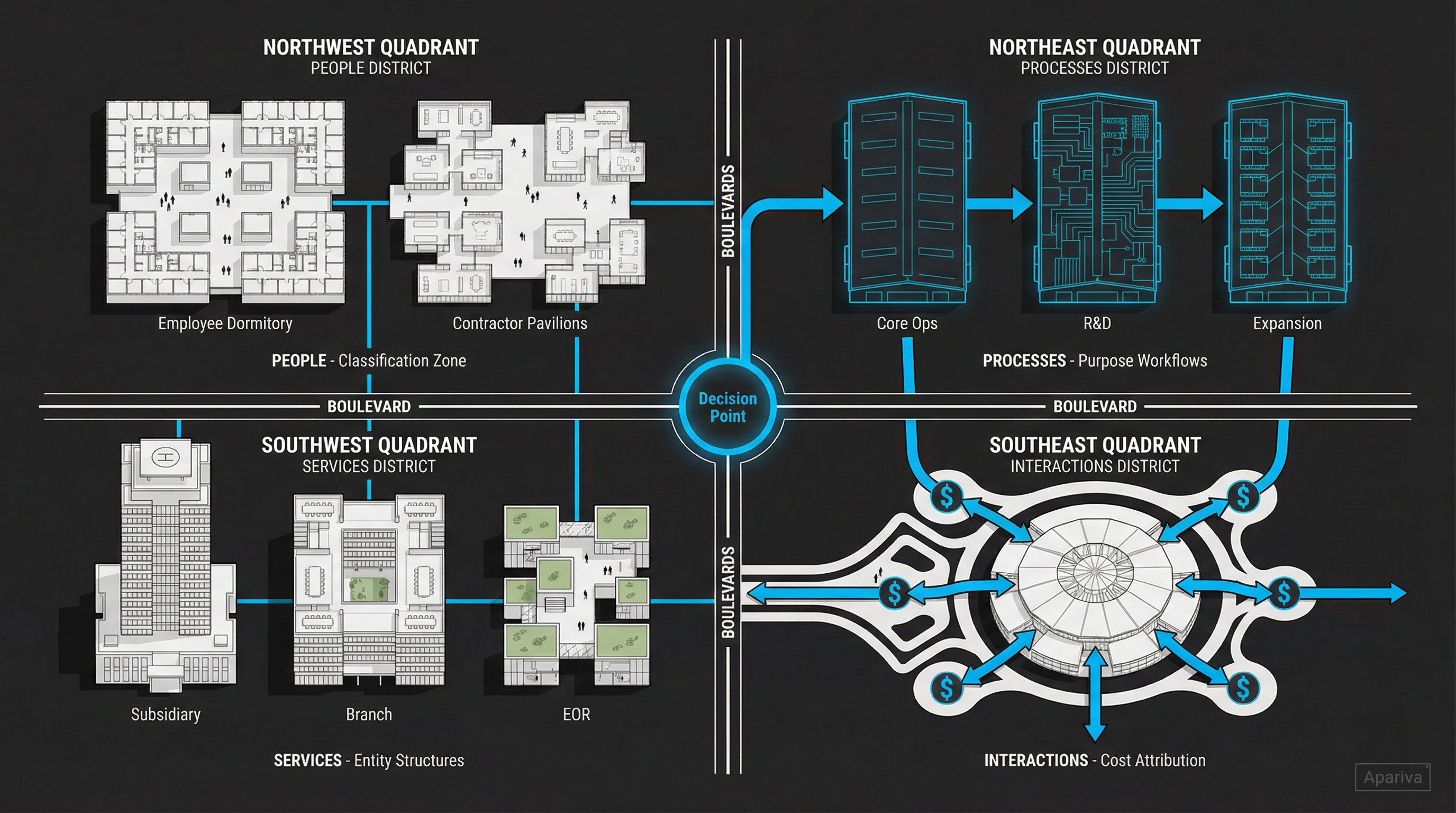
A CFO's Framework for Decision-Making
For today's CFO, workforce design is as much a financial strategy as it is an HR decision. The goal is not just to deploy talent, but to align workforce structure with tax efficiency, compliance assurance, and business outcomes.
A practical resourcing framework should consider four key dimensions:
- Purpose: Why is the role being created? Core operations, R&D, or market expansion all demand different structures.
- Jurisdiction: Where is the work performed, and what are the applicable tax, labour, and exchange-control rules?
- Engagement Type: Should the role be a direct employee, a contractor, or through an EOR (Employer-of-Record)?
- Cost Attribution: Which entity bears the cost, and how is it recovered through inter-company agreements or cost centres?
This matrix helps CFOs evaluate not only what type of workforce they need, but also how to resource it without triggering tax inefficiencies or regulatory exposure. A structured review during each budgeting cycle—integrating finance, HR, and legal—prevents downstream audit or PE (Permanent Establishment) risks.
Employee Classification Strategies
The classification of workers is the cornerstone of compliance. Misclassifying employees as contractors can invite tax penalties, disallowances, or even reputational damage.
CFOs should establish a classification governance model that integrates:
- Control and Dependence Tests: Evaluate who directs the work, provides tools, and determines schedules.
- Duration and Exclusivity: Long-term, full-time roles generally fall within employee frameworks.
- Jurisdictional Context: The U.S. applies IRS 'common law' rules, while India uses the Sham Contract doctrine; Europe's hybrid 'dependent contractor' model is evolving under the EU Platform Directive.
Where the organization operates across multiple countries, CFOs should leverage centralized policy checklists or AI-driven compliance engines within their HRIS to standardize decisions and avoid local misinterpretations. Balanced classification ensures predictable payroll tax liabilities, deductibility of costs, and legal protection in audits.
Entity Structure Optimization
Once the workforce type is determined, the next CFO challenge is allocating it to the right legal structure. Three common models dominate:
- Subsidiary: Offers full control, access to local incentives, and clean compliance; ideal for strategic markets.
- Branch: Suitable for short-term expansion but increases PE exposure and limits profit repatriation flexibility.
- Service or Cost-Plus Agreement: Effective for shared service centres or R&D hubs, maintaining arm's-length pricing per OECD and Indian Rule 10D norms.
CFOs should model tax outflows, compliance overheads, and repatriation friction under each structure. In markets with limited visibility or uncertain scale, EORs provide a compliant bridge until entity economics justify incorporation. Periodic reassessment—every 12-18 months—ensures that the structure evolves with headcount and revenue footprint.
Case Study: CFO Decision in Action
A Singapore-based SaaS firm planned to scale engineering capacity in India and sales in the U.K. The CFO applied a structured resourcing matrix:
| Function | Engagement Model | Entity Decision | Result |
|---|---|---|---|
| Engineering | Direct employment | Indian subsidiary under cost-plus 12% | Optimized tax deductibility and ensured FEMA compliance |
| Sales | EOR model (first 6 months) | Transition to U.K. subsidiary post-revenue threshold | Avoided premature PE risk and reduced initial setup cost by 22% |
By sequencing the resourcing model and entity structure, the CFO balanced speed, compliance, and cost efficiency—transforming workforce expansion into a controlled financial lever rather than a regulatory gamble.
Section 3: Compliance as Competitive Advantage

For forward-looking CFOs, compliance is no longer a defensive necessity—it is a strategic advantage that can shape the organization's operating model, tax efficiency, and global credibility. The most successful companies are those that design their resourcing and costing frameworks around regulatory foresight, not after-the-fact correction. Regulations define not only what is permissible, but also what is financially optimal when aligned with tax structures, entity design, and talent strategies.
3.1. How Regulations Shape Optimal Models
Modern CFOs must view compliance as an enabler of structural clarity. Regulatory frameworks—tax, labor, and corporate—determine the most cost-efficient way to employ or engage talent across jurisdictions. For example, aligning employee costs with revenue-generating entities allows full deductibility and arm's-length transparency under transfer pricing rules, while structuring inter-company services under compliant cost-plus agreements reduces audit exposure.
Moreover, well-governed compliance ecosystems inspire investor and regulator confidence, which in turn lowers financing costs and enhances valuation multiples. A CFO-led compliance approach, therefore, transforms mandatory filings into strategic governance instruments that signal maturity and risk discipline.
3.2. India-Specific Considerations: FEMA, Companies Act, and Income Tax
India's regulatory ecosystem provides both opportunities and pitfalls for multi-jurisdictional organizations.
Under the FEMA, cross-border payments for employees, contractors, or seconded staff must follow prescribed channels. For instance, when foreign entities fund Indian salaries, the structure must align with FDI and ODI norms, and any inter-company reimbursements should comply with RBI-approved mechanisms.
The Companies Act, 2013, influences how employee costs are disclosed, approved, and reported—especially managerial remuneration, related-party transactions, and CSR-linked workforce spending. CFOs must ensure that payroll reporting, cost capitalizations, and board disclosures align with the Act's transparency obligations.
On the Income Tax front, compliance extends beyond TDS deductions to include shadow payrolls for expatriates, ESOP perquisite valuation, and transfer pricing documentation for cross-border staff allocations. A misstep here not only triggers financial penalties but can distort effective tax rates, undermining the company's cost optimization objectives.
3.3. International Coordination
For CFOs managing distributed teams, international regulatory coordination is the cornerstone of scalability. Each country's payroll, social security, and labor obligations must feed into a unified compliance architecture. Coordinated tax equalization policies, standardized entity interlinkages, and synchronized reporting (e.g., Base Erosion and Profit Shifting - BEPS Action 13 refers to Transfer Pricing Documentation and Country-by-Country Reporting, Foreign Account Tax Compliance Act - FATCA, Directive on Administrative Cooperation, 6th amendment - DAC6) prevent double taxation and reputational risk.
A globally coordinated compliance model—anchored by local expertise and centralized oversight—becomes a competitive differentiator. It assures investors, simplifies audits, and empowers the CFO to balance cost efficiency with regulatory resilience, turning compliance into a durable strategic asset.
Section 4: Measuring Success - Turning Workforce Costs into Strategic Intelligence
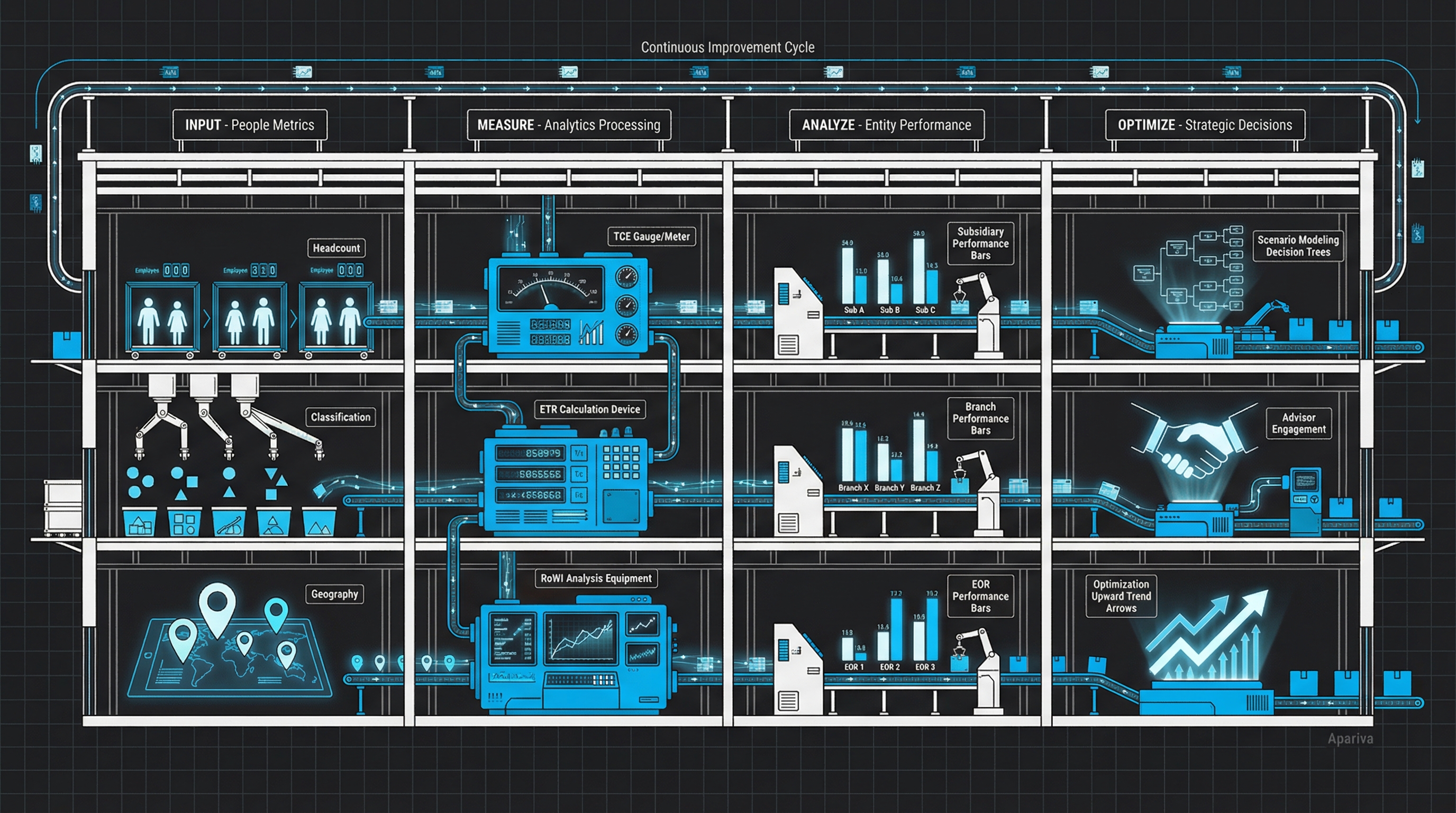
For CFOs, optimizing employee resourcing is not a one-time structural exercise—it's a continuous performance measurement discipline. Success lies in translating workforce cost data into actionable financial intelligence that aligns with business strategy, tax efficiency, and compliance resilience.
Key Metrics to Track
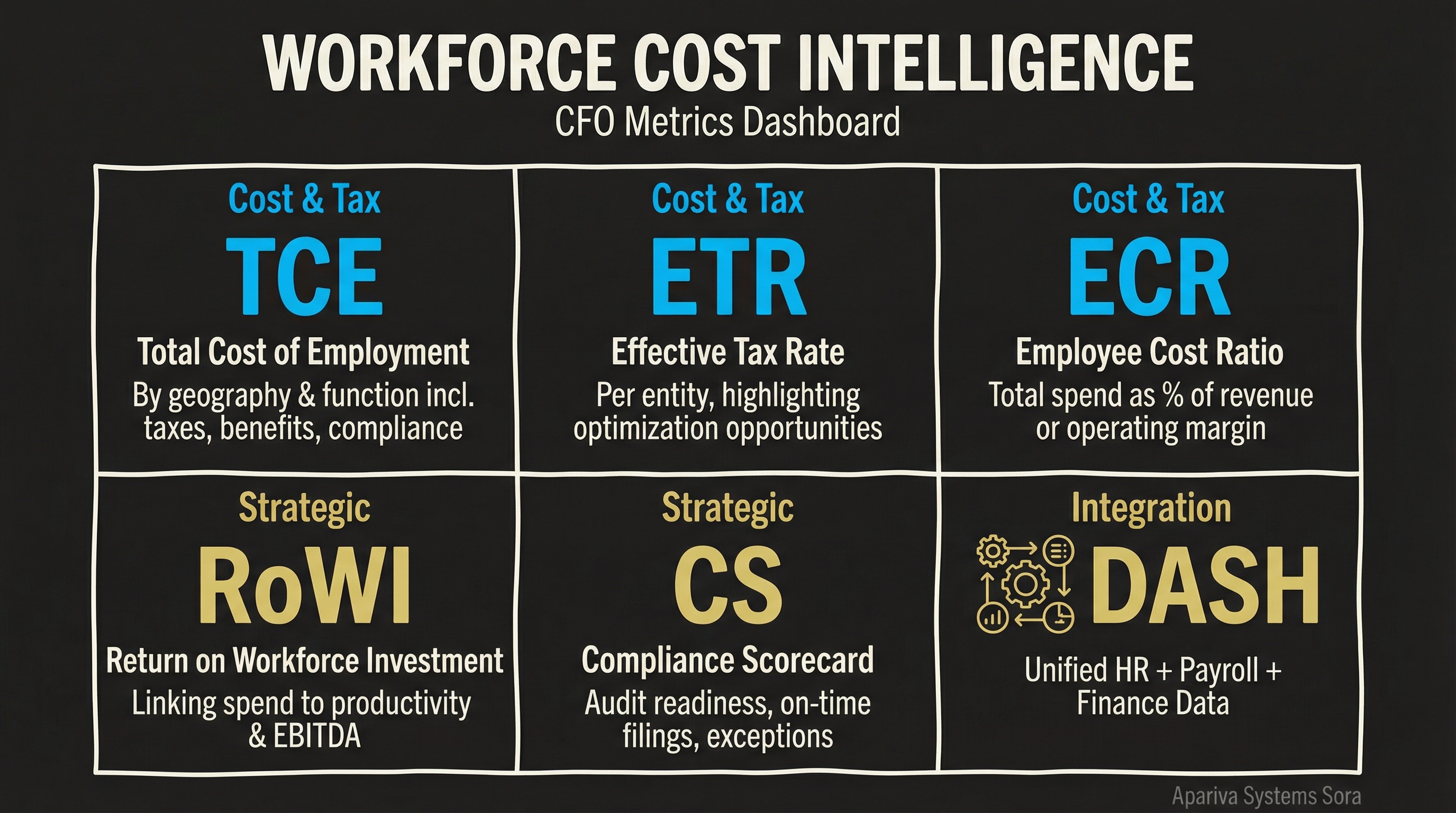
CFOs should maintain a Workforce Cost Intelligence Dashboard that integrates HR, payroll, and finance data. Key indicators include:
- Total Cost of Employment (TCE) by geography and function, including taxes, benefits, and compliance overhead.
- Effective Tax Rate (ETR) for each entity, highlighting optimization opportunities.
- Employee Cost Ratio (ECR) - total employee spend as a percentage of revenue or operating margin.
- Return on Workforce Investment (RoWI) - linking resourcing spend to productivity, revenue, and EBITDA contribution.
- Compliance Scorecard - tracking audit readiness, on-time filings, and regulatory exceptions.
Evaluating Different Scenarios
Scenario modeling allows CFOs to simulate the financial and compliance impact of alternate resourcing strategies:
- EOR vs. Subsidiary Hiring: Compare long-term tax savings against upfront setup costs.
- Contractor vs. Employee Mix: Evaluate flexibility benefits versus misclassification risks.
- Offshoring vs. Onshoring: Assess currency, labor cost, and PE exposure under varying tax jurisdictions.
Using integrated FP&A and workforce analytics tools, CFOs can model 'what-if' scenarios that quantify not just cost differentials but also the associated regulatory and reputational risk.
When to Engage Financial Advisors
CFOs should engage tax and transfer pricing advisors when:
- Expanding into new jurisdictions with complex payroll and FDI implications.
- Planning cross-border M&A or inter-company service agreements.
- Conducting ESOP/409A valuations or designing global equity programs.
Periodic third-party reviews enhance governance credibility and ensure compliance-aligned optimization, enabling CFOs to sustain workforce agility while safeguarding financial integrity.
Conclusion & Call to Action
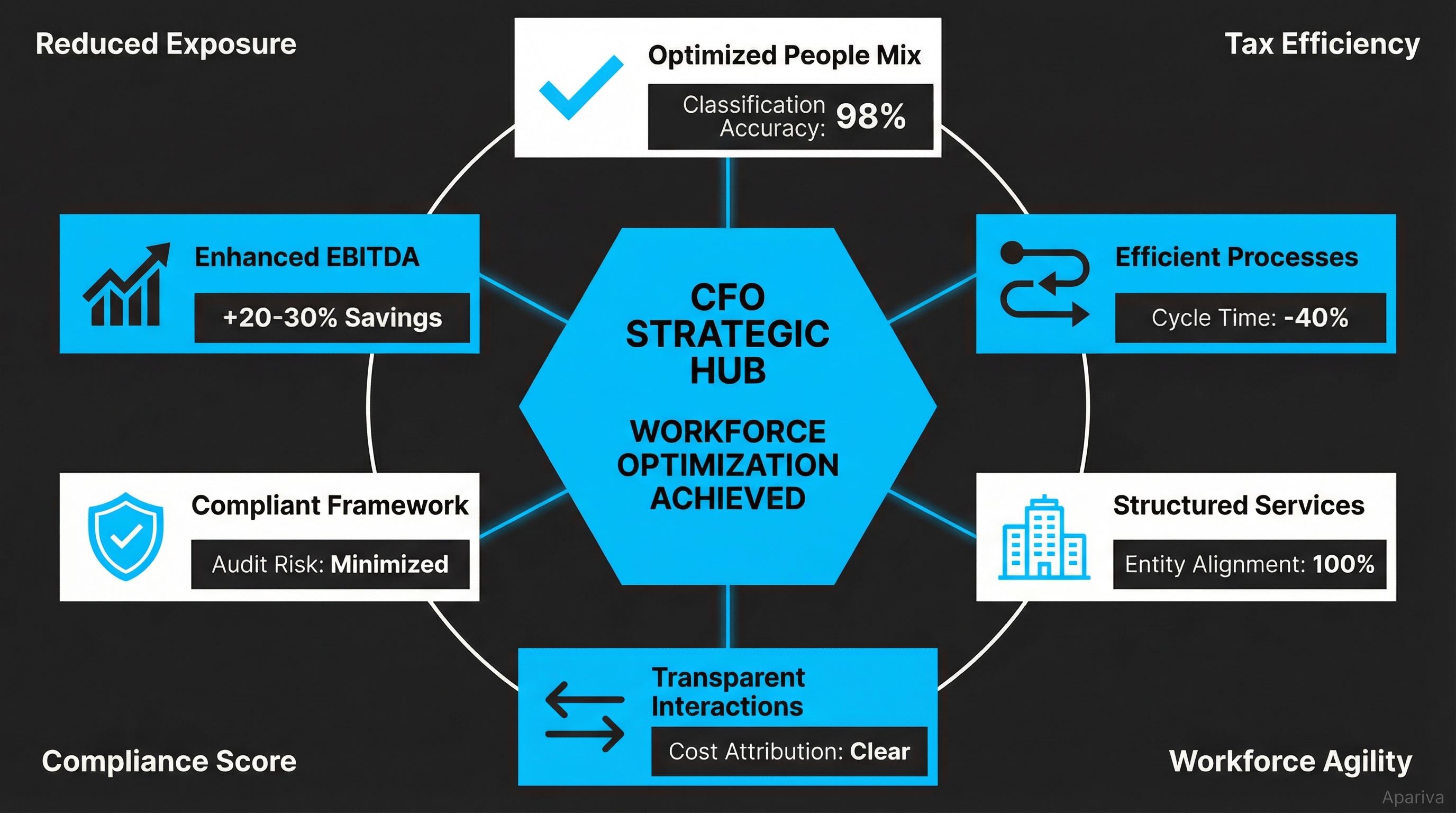
In an increasingly borderless business environment, employee resourcing and costing optimization has become a core responsibility for forward-looking CFOs. The key takeaway is clear - aligning workforce structures with tax efficiency, regulatory compliance, and business strategy can directly enhance EBITDA, reduce global exposure, and strengthen investor confidence. Effective resourcing is not just about cutting costs; it's about designing sustainable, compliant, and value-creating models that connect talent deployment to measurable business outcomes.
CFOs leading multi-entity or multi-geography operations should now reassess their current resourcing and costing frameworks. Are inter-company allocations tax-efficient? Are entity structures compliant with FEMA, FDI, and transfer pricing norms? Are your TCE (Total Cost of Employment) metrics aligned with profitability and risk indicators? A strategic review can reveal hidden inefficiencies and compliance exposures that impact long-term valuation.
Our Virtual CFO Services specialize in diagnosing, restructuring, and optimizing global resourcing models - combining financial foresight with compliance intelligence. We help organizations transform payroll data into strategic decision dashboards, ensuring every dollar of workforce spend drives sustainable growth.
Take the first step today - schedule a Virtual CFO assessment to benchmark your organization's current model and unlock measurable, compliant efficiency across your global workforce.